Seating arrangement is very familiar for the aspirants who are preparing for the bank exams. Compared to the other Competitive exams in Bank related exams the weightage for Seating Arrangement is more. Both in Prelims and Mains Examination ample number of questions are asked from Seating Arrangements.
It is not at all surprising to say that Seating arrangement plays a crucial role in your Success. Now, let us see the rules useful while solving the Seating Arrangements. Also, how to train your Brain for seating arrangement.
Train Your Brain:
First of all to become master in Seating arrangement Questions you need to accept certain facts and train your brain accordingly.This is not a 20-20(Twenty-Twenty) Game:
I mean to say within a few hours or with practising once in a fortnight one cannot crack the seating arrangement. One should have a regular practice till one reaches a threshold level.It is a test match Initially:
It is common for every aspirant to take more time while solving the seating arrangement initially (no one is special here all are common people here -Aam Admi..)
Do not run blindly Without Hitting The Ball:
While you practice take ample time to read each and every word of the question so that you can understand and Twists and Turns of the Seating Arrangement. Once you do in this way automatically your Brain identifies the Logic in the arrangement while you are attempting the Actual examination. But Do not blindly Start the arrangement.
Never Try To be Dhoni In Exam:
Many aspirants commit a mistake of attempting a Huge puzzle in the last 2 or 3 minutes of the exams, if one can crack the arrangement, then well and good but if not you are wasting the Two valuable minutes in the exam. In this case, try for puzzle with least information Given (like question given in less number of lines).
Learn Every shot Before the match:
Practice each and every format of seating arrangement before the exam. Even though every exam has surprising elements one should have sound knowledge on every format of seating arrangement questions.
No one can Win a match in Single Ball/over:
Never think to solve Seating arrangement in single diagram. Messing up all the information in a single diagram either create confusion or miss some important points. This also wastes time to figure out actual diagram.
Practice Good Number of MOCKS:
Last but not least this differs the winner and runner. Practicing mocks helps you to reduce the number of scrolls per Question, with this ultimately one can gain advantage over other candidates and can get good number of attempts.
In present scenario, reasoning section is completely filled with seating arrangement questions and Puzzles. In recent IBPS PO prelims, 20-25 questions out of 35 Questions are from this section. We can expect the same percentage of questions in the Mains examination.
First, let us differentiate Puzzles and seating arrangement
If the question is like this then one should start with A is sitting 3rd to the right of B. Because this is only the confirmed information.
Note: If nothing is mention regarding the direction they are facing like facing towards center or facing away from centre then by default take it as facing centre.
In present scenario, reasoning section is completely filled with seating arrangement questions and Puzzles. In recent IBPS PO prelims, 20-25 questions out of 35 Questions are from this section. We can expect the same percentage of questions in the Mains examination.
First, let us differentiate Puzzles and seating arrangement
| Seating Arrangement | Puzzles | |
|---|---|---|
| Pattern | Some information regarding the persons and how they are seated is given and one should arrange them either in a Liner or circular or any other as mentioned. | Some information regarding persons and their interests are given. one need to match them and arrange them accordingly |
| Maximum number of variables | Maximum three variables like Gender, Blood relation, Direction of facing are incorporated in the question. Some other information like occupation, companies etc,, may be given. | Upto 4 variables can be asked. like Floors, Occupation, Vehicles, mobiles used etc.., |
| Integration with other topics | Blood relation, ages, ranking may be incorporated | Blood relation, ages, ranking may be incorporated |
| Maximum number of persons | 10-12 persons can be given in the mains examinations. In general 8 persons are given | 10 persons can be given |
| Types of Figures asked | Linear Circular Square Pentagon Octagon Any closed figure | Floor based arrangement |
5 Golden Rules
Rule 1: Always start the arrangement with 100% fixed information
Example: 8 persons A,B,C,D,E,F,G,H are sitting around a circular table . A is sitting 3rd to the right of B, C is sitting opposite to D who is 3rd left to the person opposite to A…………………… so on.If the question is like this then one should start with A is sitting 3rd to the right of B. Because this is only the confirmed information.

Rule 2:
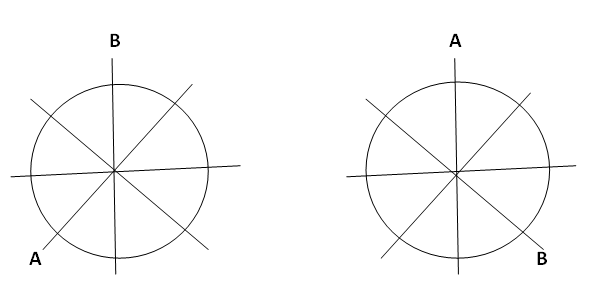
For a closed figure (circle, square, rectangle , octagon etc..,) arrangement, Only persons sit opposite to each other when there are even number of members.

In a given arrangement if four persons are given as in first diagram then two persons can be accommodated exactly opposite to each other but not in case of figure (ii)

In this case WHO refers to B: Thus A is placed right to B and B is placed left to C.
 In this case AND refers to A: Thus A is placed left to C as well as right to B.
Example: 5 persons standing in a row ,namely X,Y,Z,P,A. No one sits left to the vowel. Only 3 persons are to the right of X. X sits immediate left of Y and left to Z. Z does not sit at extreme ends.
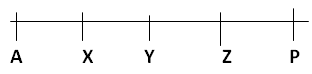
In the Above arrangement, X is immediate left to Y, whereas X is left to Z. No matter how many places far from Z but it is left to Z.
For Circular/closed figure:

Towards left go for clockwise rotation.
These are the important rules one should be aware of while solving seating arrangement questions. A competitive exam needs speed, but not hurry.

In a given arrangement if four persons are given as in first diagram then two persons can be accommodated exactly opposite to each other but not in case of figure (ii)
Rule-3: “And” vs “Who”
In a given question if it is given as- In a circular arrangement, there are four persons A, B, C, D sitting in the following way. A is right of B, who is left of C

In this case WHO refers to B: Thus A is placed right to B and B is placed left to C.
- In a circular arrangement, there are four persons A, B, C, D sits in the following way. A is right of B and is left of C

Rule 4: Left vs Immediate left
Either in circular or linear arrangement unless it is mentioned in the question we cannot assume left an immediate left.Example: 5 persons standing in a row ,namely X,Y,Z,P,A. No one sits left to the vowel. Only 3 persons are to the right of X. X sits immediate left of Y and left to Z. Z does not sit at extreme ends.

In the Above arrangement, X is immediate left to Y, whereas X is left to Z. No matter how many places far from Z but it is left to Z.
Rule 5: Identifying the left and right in a given arrangement

Whenever it is given towards right go for anti-clockwise direction.
Whenever it is given Towards left go for clockwise rotation.
These are the important rules one should be aware of while solving seating arrangement questions. A competitive exam needs speed, but not hurry.