INTRODUCTION
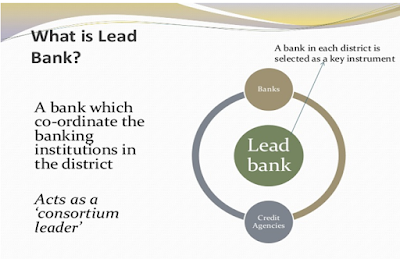
The National Credit Council was set up in Dec-1967 to regulate the priorities of bank credit among various sectors of the economy. The National Credit Council appointed a study group on the administrative context for the implementation of social objectives in Oct-1968 under the Chairmanship of Prof. D R Gadgil. The study committee found the following points. Report was submitted on Oct-1969.- The nationalized banks provide 83% of total credit.
- Out of 2700 towns banking facilities are available only in 617 towns.
- 5000 villages not covered by Commercial banks.
Prof. D R Gadgil committee recommended the following points.
- Banks should provide integrated banking facilities in unbanked areas.
- Adoption of ‘Area Approach’ – in unbanked areas –each bank should adopt an area.
- Help Agriculture & Supplemental Security Income (SSI).
- ‘District’ identified as the smallest geographical unit for the scheme.
OBJECTIVES
- Eradication of unemployment and under employment.
- Considerable rise in the standard of living for the deprived of the poor.
- Provision of some of the basic needs of the people who belong to poor sections of the society.
FUNCTIONS
- To analysis the resources & potential for banking development by identifying unbanked centers in the allotted districts.
- To identify the industrial & commercial units which do not have bank accounts or depend mainly on money lender.
- To identify & study local problems.
- To set up branches in a phased manner.
- To keep contacts & liaison regularly with government & semi-government agencies.
- To provide assistance to the primary lending agencies.
Advantages from the scheme
- Spread the availability of banking facilities all over the country.
- Interlink the commercial & co-operative banks.
- More effective branch expansion.
- Better relationship b/w government & banks.
- Integration of credit activities of banks.
- This scheme would assist in implementation of District Plan.
District Credit Plans (DCP’s)
- It was implemented in 1974.
- It consists of technically & economically viable schemes which can be taken up for financing.
- It is a plan of bankable schemes in agriculture, industry & services sectors of the district.
- Implement the program in collaboration with other institutions.
- Monitor progress & evaluate progress in achieving targets.
Progress of Lead Bank Scheme
By 1974 –90% of geographical areas in Assam, Bihar, West Bengal, Orissa, Madhya Pradesh, Uttar Pradesh was covered.The study committee appointed by RBI in Gujarat & Maharashtra concluded the following points.
- Lead Banks were successful in identifying potential area for new branches.
- Formulation & implementation of DCP’s was slow.
- They suggested preparation of Annual Action Plans followed by Annual Credit Plans (ACP’s).
- By mid 90s, the lead bank scheme covered 493 districts.
PROBLEMS
- There is a confusion regarding the concept of ‘Lead Bank’ especially for opening branches –ambiguous scope & objectives.
- Lag in Co-ordination & effective functioning b/w banks & financial institutions.
- Problems in allotment of Districts.
- Problems in preparation & uniformity of DCP’s.
- Did not consider the role of Co-operatives which is the important source of institutional finance.